South Korea: Imported ferrous scrap arrivals up w-o-w
Imported ferrous scrap arrivals in South Korean ports were up roughly by 12,000 tonnes (t) this week to 92,336 t from last week. However, this was less than the same peri...
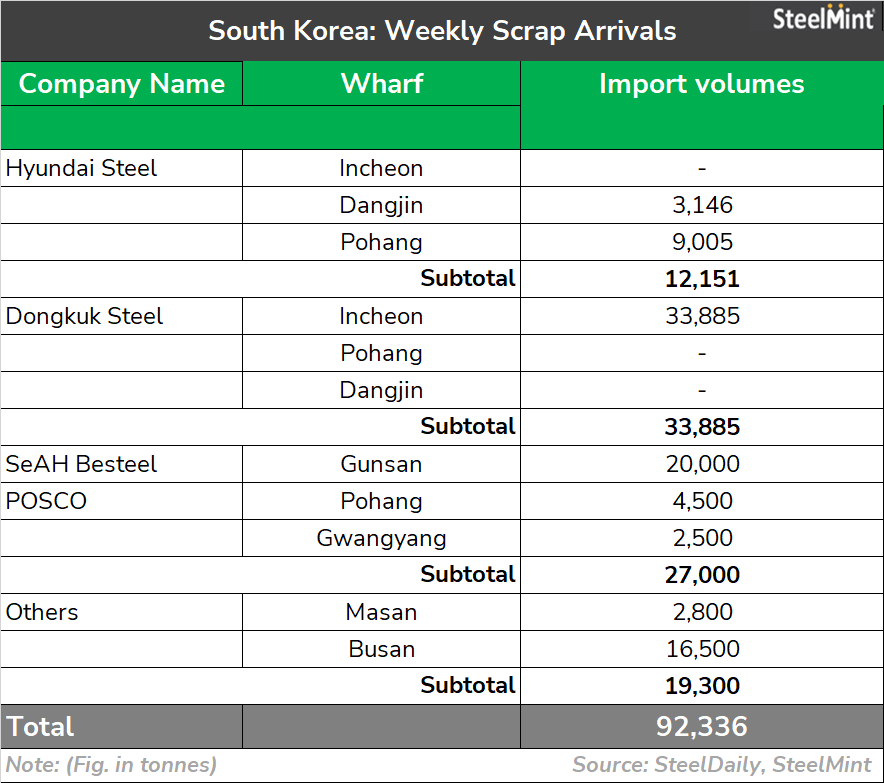

Imported ferrous scrap arrivals in South Korean ports were up roughly by 12,000 tonnes (t) this week to 92,336 t from last week. However, this was less than the same period last year. Hyundai Steel’s scrap imports continued to decline noticeably w-o-w.
Company-wise imports
- Hyundai Steel: Hyundai Steel did not import from the Incheon port this week. But had imported 3,146 t and 9,005 t of scrap from Dangjin and Pohang, respectively, totalling 12,151 t. Compared to last week, when 13,432 t came in, the share of total import fell by almost 13%.
- Dongkuk Steel: Dongkuk Steel’s entry of scrap has been steady w-o-w. It imported 33,885 t of scrap from Incheon alone, which was largely stable with a slight rise compared to the volumes arrived last week. Since March 2023, the company has reported receiving over 30,000 t of iron scrap.
Additionally, SeAH Besteel imported 20,000 t via Gunsan Port, which was typical for a week. This was an increase of about 2,000 t from last week. It continued to have the most “consistent” port arrivals in 2023.
- POSCO: POSCO supplied 4,500 t to Pohang and 2,500 t to Gwangyang, respectively. The stated tonnage, which had increased to 40,000 t by mid-March when imports started, once more dropped below 10,000 t. However, Gwangyang Port handled an import of 8,400 t of pig iron.
- Daehan, YK, and Korea Steel: Korea Steel imported 2,800 t at Masan Port. Meanwhile, Daehan Steel and YK Steel imported 11,500 t and 5,000 t, respectively.
By grade, imports of raw iron declined considerably, shredded was 5,000 t, shindachi was 7,000 t, HS was 1,005 t, and H2 was 9,000 t.
Note: This article has been published in accordance with an article exchange agreement between SteelDaily and SteelMint.