Pakistan: Imported ferrous scrap prices rise $6/t w-o-w; buyers cautious amid rising freight rates
Imported shredded scrap in Pakistan was offered at $440-445/tonne (t) and witnessed a rise of $4-6/t w-o-w despite cautiousness among the majority of buyers due to rising...
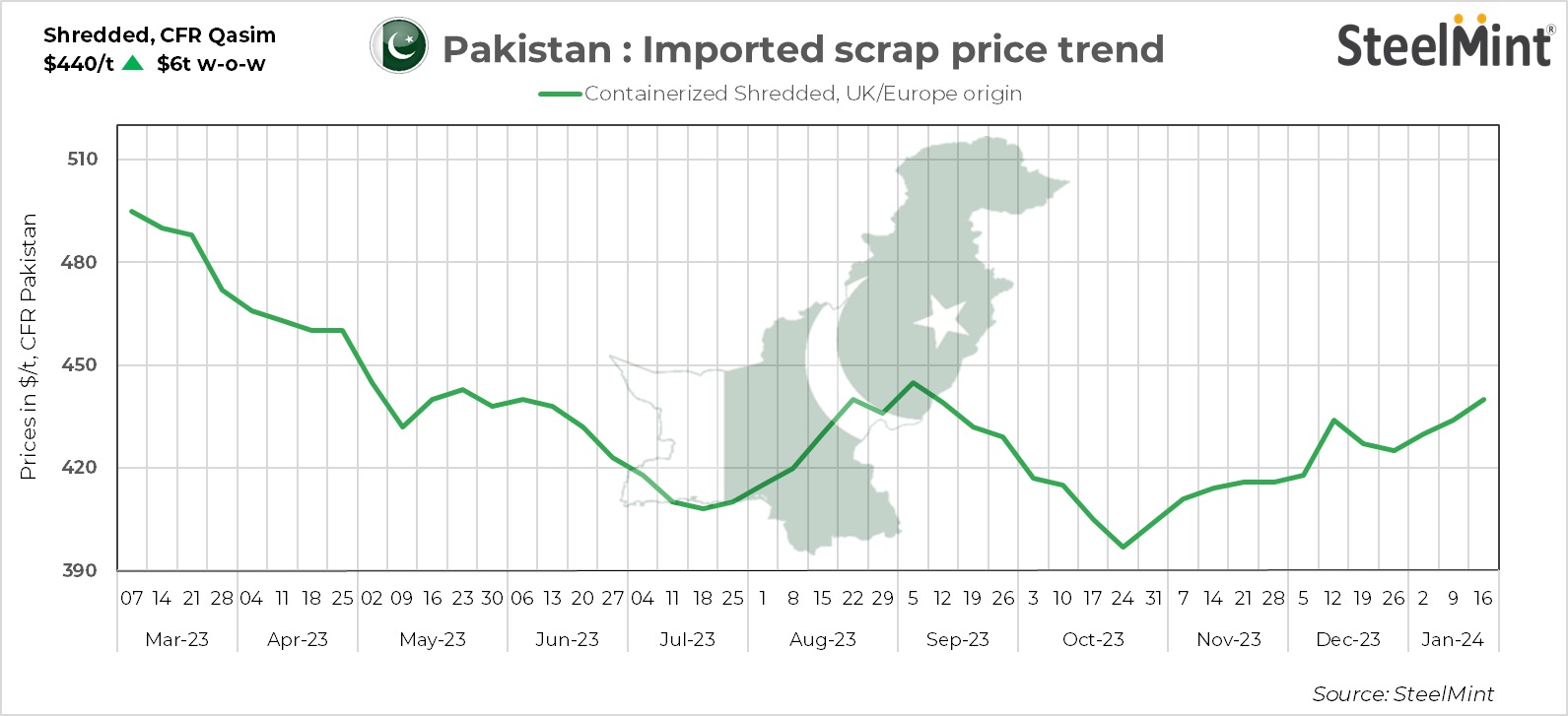

Imported shredded scrap in Pakistan was offered at $440-445/tonne (t) and witnessed a rise of $4-6/t w-o-w despite cautiousness among the majority of buyers due to rising freight rates.
Throughout this week, around 5,000 t of shredded scrap were sold at $430-440/t from the Middle East in varied portions while 500 t of fabrication scrap, also from the Middle East, were booked at $435/t on CFR Qasim basis. Further, an additional 300 t each of shredded and fabricated, of Middle East origin, were booked at $445/t and $427/t respectively. Around 3,000 t of shredded from Europe were sold at $435/t followed by 1,000 t of shredded at $437/t, CFR Qasim.
As per market sources, Europe-origin material booking resumed via the Suez Canal route but with extra caution and at a higher freight rate
A steel mill source mentioned, “Recent offers from the UK are at 440/t and EU other regions were at $440-450/t, depending on the shipment days, whereas the Middle East offers were at $435-440/t with the assurance of 7-10 days’ shipments.”
SteelMint’s European-origin shredded scrap assessment stood at $440/t, witnessing an increase of $6/t w-o-w.
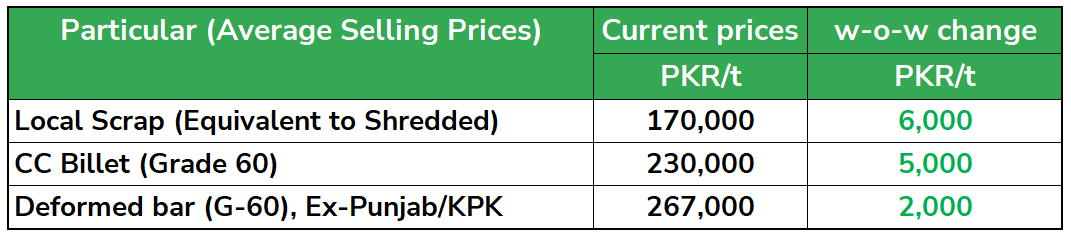
Domestic market: In the domestic market, local scrap prices ranged from PKR 165,000-170,000/t exw Punjab, with workable levels for grade 60 rebars at PKR 265,000-270,000/t exw Punjab.
In recent developments, on 13, January, a PKR 3,000/t increase was effected in Grade 60 bars. But the market conditions are still the same as last week.
As per a local steel mill representative, very weak demand has been observed so far due to cold weather in Punjab and uncertain economic conditions due to the coming elections.
Exchange rate: The Pakistani rupee marked its ninth consecutive session of gains, settling at PKR 280.24 against the US dollar, as reported by the State Bank of Pakistan (SBP). Internationally, the dollar strengthened following cautious remarks from European Central Bank officials, leading investors to reconsider expectations of near-term US Federal Reserve rate cuts.
Meanwhile, oil prices exhibited mixed trends on Tuesday, influenced by broader economic concerns, US demand-supply issues, and ongoing tensions in the Middle East, prompting further diversions of tanker routes.
Energy sector: Pakistan’s circular debt in the energy sector has surged to PKR 5.73 trillion, surpassing the earlier estimate reported to the IMF by PKR 1.5 trillion. The breakdown reveals power sector dues exceed PKR 2.7 trillion, while the gas sector owes over PKR 3 trillion. This debt represents 5.4% of Pakistan’s GDP, highlighting the inefficacy of tariff hikes in addressing the circular debt issue. Despite tariff increases, affordability remains a concern. The government’s strategies face scrutiny, and a proposed plan to reduce circular debt awaits approval from the IMF. China conditions a $600 million loan on settling a portion of the debt. Public sector companies reported combined losses of PKR 730 billion in 2022, prompting debates on privatisation or outsourcing.
Outlook: Market sentiment indicated a calm outlook, with a nominal hike in further inquiries, because buyers and traders will closely monitor the impact of rising freight rates on the back of the Suez Canal issue.

